Stop answering records requests by hand.
FreeEed searches the whole mailbox, culls it down to what is actually responsive, and exports clean per-document PDFs — on a machine you control, so nothing ever leaves the building. Free and open source.
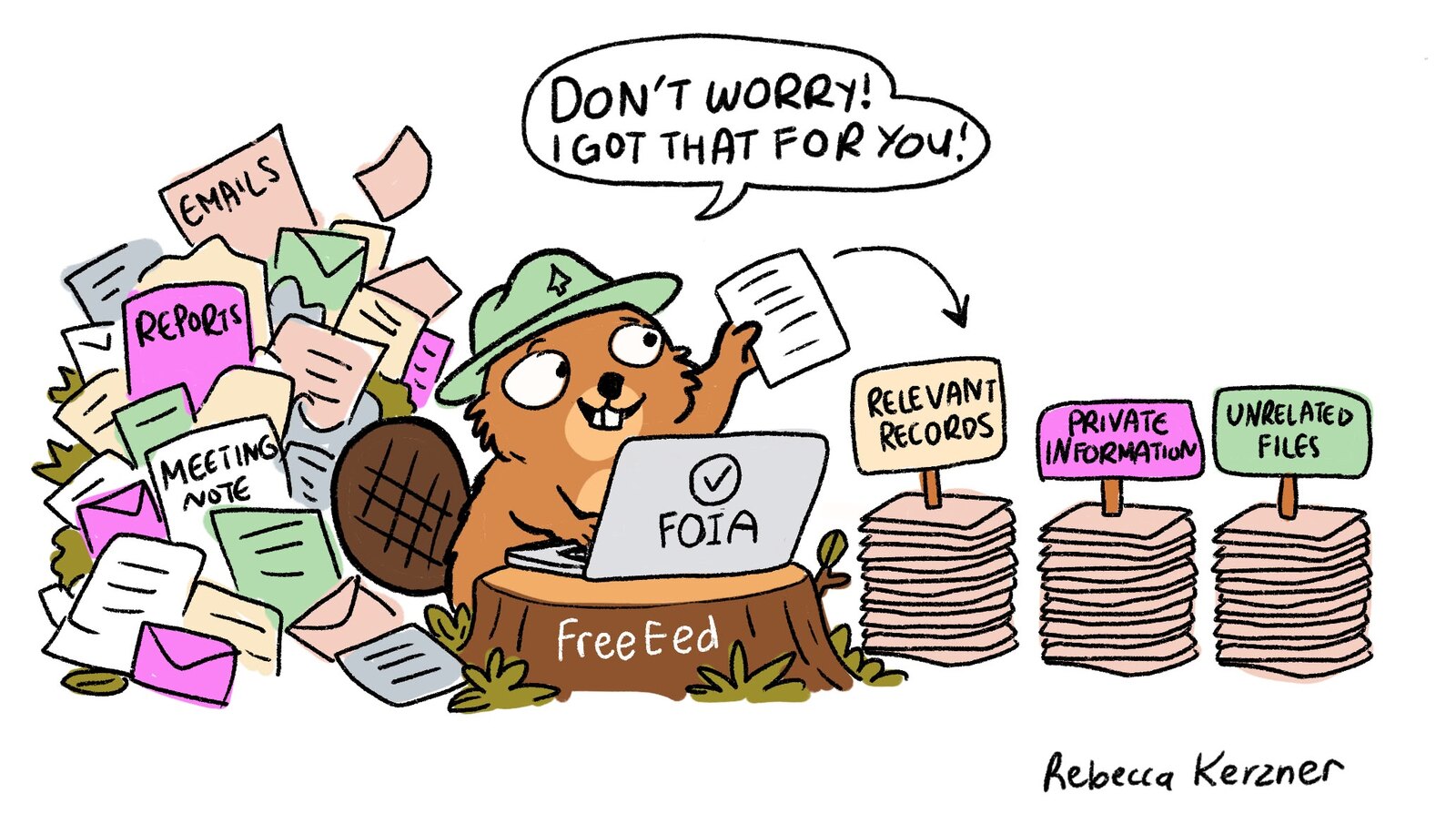
The way this works now.
You get the request. You pull the custodian’s mail into a PST or an mbox, or you ask IT to. Then you open it and start reading, because that is the only way to know what is responsive. You save the ones that count into a folder, one at a time, and the attachments come out named image003.png. You open each one in Acrobat, draw the boxes, flatten it, and hope nothing was missed. You number the pages. You zip it. Then the next request arrives.
Nothing in that process is a software problem except the first half — and that is the half nobody sold you a tool for.
FOIA on the desktop.
Every other tool for this is a cloud platform: a tenant, a portal, a login, a subscription, a procurement cycle, and a conversation with your attorney about where the data lives. FreeEed is a desktop application. You download it and it runs on the machine on your desk — the same machine where the mailbox export already landed. The records never move.
Nothing to buy
Downloading software is not a purchase. No RFP, no vendor onboarding, no security questionnaire, no budget line. You can try it on your next request this week without asking anyone.
No login, no tenant
There is no “where is our data” question to answer, because the answer is: on your machine, where it already was.
It keeps working
Open source. If you stop paying for support, the tool still runs and your past requests are still yours.
Already have a portal for intake? Good — keep it. FreeEed does not take requests, run your clock, or send correspondence. It does the part that happens after: getting from a mailbox to the documents you actually have to produce.
Tell us how you handle records requests
Five quick questions. Your input shapes what we build next — it’s not a sales form.
Share your input →Public records contain things that can’t go to the cloud.
Personal information. Exempt material. Student and personnel data. FreeEed runs entirely on your own machine or server — no upload, no third party, no per-gigabyte cloud bill. When AI assists, it runs locally, so you can certify that nothing was ever sent out. It’s the same court-defensible, on-prem approach agencies and firms already trust for litigation, brought to public records.
One request, one clean machine.
Download the FreeEed appliance, spin up a fresh virtual machine for each request, load the records, and work the whole thing in one self-contained place. When you’re done, archive or delete the VM.
Isolated
Each request lives in its own environment — a clean chain of custody, with no crossover between matters.
Boot and go
Runs on the virtualization you already have — VMware, VirtualBox, Hyper-V, Proxmox. No install, no dependency hunt.
Yours
Self-hosted on your hardware, free to run forever. No account to keep, no data held hostage.
From a pile of email to a finished response.
Ingest
Pull in email, PST and mbox exports, and loose files — including exports from Google Vault and Microsoft 365.
Search & cull
Full-text search across everything, then narrow to what’s actually responsive to the request.
Review
Read and tag documents in a browser-based review view.
Produce
Export the responsive documents as individual PDFs, ready to hand off.
Google Vault → mbox → FreeEed → PDF.No per-page pricing. No lock-in.
FreeEed is free and open source — every feature, including local AI, works whether you pay or not. Optional support is a flat rate, never billed by volume or by the gigabyte. Cancel anytime and your work keeps running.
- Free forever for the full desktop tool
- Optional support at a flat monthly rate — never per gigabyte
- Built for the small agencies the litigation platforms were never priced for
Continuous updates, support, and hosted capabilities. Flat — no volume charge, ever.
Start freeA PDF editor can’t read your mailbox.
Acrobat is good at what it does: one document, one page, one box at a time. A records request is not one document. It is a mailbox — and the work that eats the week happens before any PDF is open: figuring out which messages are responsive, which are duplicates, which thread they belong to, and which custodian they came from.
Search everything at once
Full-text search across the whole collection, including attachments, instead of scrolling a mailbox by eye.
Duplicates and threads collapse
The same message forwarded nine times is one thing to review, not nine.
Email becomes documents properly
Mail and attachments convert to per-document PDFs with the parent–child relationship intact, instead of being saved out by hand.
The work is recorded
What was searched, what was reviewed, what was produced — the record you need when someone asks how you decided.
On redaction, plainly. The well-known failure is a black box drawn as a shape over text that is still there underneath, copy-pasteable by whoever receives the file. Acrobat’s redaction tool, used properly, removes the content — the problem is doing it three hundred times on a deadline, where one shortcut is all it takes. FreeEed’s own redaction is new and we are honest about where it stands: manual, in preview, being validated with a design partner now. What ships today is everything before it — getting you to the right documents, so the set you are marking up is forty pages and not four hundred.
Count the hours on your last request.
How long did it take, start to finish? How much of that was reading mail to find what was responsive? Run your next request through FreeEed on your own machine and compare. It is free, it installs today, and nothing leaves the building.